
The Seven Last Words, by Venerable Fulton John Sheen
The Seventh Word
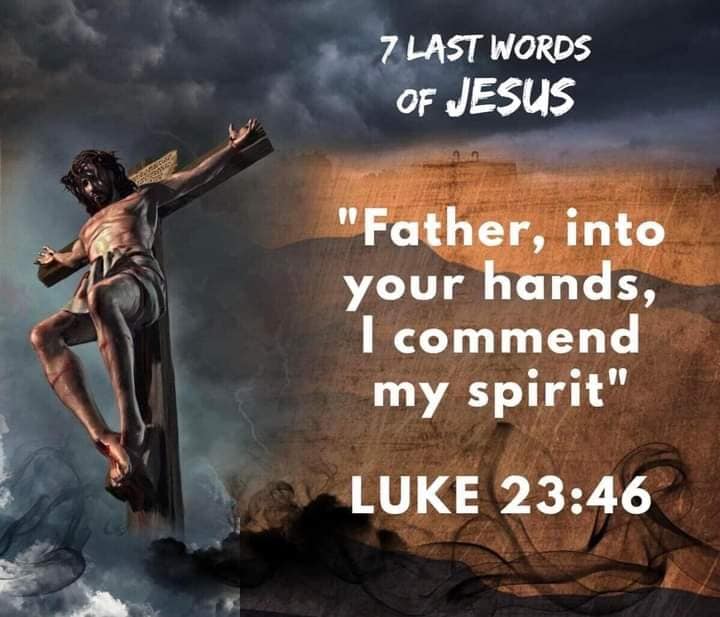
Father, into Thy hands I commend My Spirit.
When Adam had been driven from the Garden of Paradise, and the penalty of labor imposed upon him, he went out in quest of the bread he was to earn by the sweat of his brow. In the course of that chase, he stumbled upon the limp form of his son, Abel, picked him up, carried him upon his shoulders, and laid him on the lap of Eve. They spoke to him, but Abel did not answer - he was never so silent before. They lifted his hand, but it fell back limp - it had never acted that way before. They looked into his eyes, cold, glassy, mysteriously elusive - they were never so irresponsive before. They wondered, and as they wondered, their wonder grew. Then they remarked: "For in what day soever thou shalt eat of the tree, thou shalt die the death." It was the first death in the world.
Centuries whirled around into space, and the new Abel, Christ, is put to death by His jealous brethren of the race of Cain. The life that came out from the boundless deep now prepares to go back home again. His sixth word was a cry of retrospect: "I have finished the work." His seventh and last one is a word of prospect: "I commend My Spirit." The sixth word was manward; the seventh word was Godward. The sixth was a farewell to earth; the seventh His entrance into Heaven. Just as those great planets only after a long time complete their orbit and return again to their starting point, as if to salute Him Who sent them on their way, so too, He Who had come from Heaven had finished His work and completed His orbit, now goes back to the Father to salute Him Who sent Him out on the great work of the world's redemption.
The Prodigal Son is returning to His Father's house, for is not Christ the Prodigal? Thirty-three years ago He left His Father's eternal mansion and went off into the foreign country of this world. Then He began spending Himself and being spent; dispensing with an infinite prodigality the divine riches of power and wisdom and bestowing with an heavenly liberality the divine gifts of pardon and mercy. In this last hour His whole substance is wasted among sinners, for He is giving the last drop of His precious blood for the redemption of the world. There is nothing to feed upon except the husks of human sneers and the vinegar and gall of bitter human ingratitude. He now prepares to take the road back again to His Father's house, and as yet some distance away He sees the face of His Heavenly Father and breaks out into the last and perfect prayer from the Pulpit of the Cross: "Father, into Thy hands I commend My Spirit."
All the while Mary is standing at the foot of the Cross. In a short time the new Abel, slain by His brethren, will be taken down from the gibbet of salvation and laid in the lap of the new Eve. It will be the death of Death! But when the tragic moment comes it may seem to the tear-dimmed eyes of Mary that Bethlehem has come back. The thorn-crowned head which had nowhere to lay itself in death, except on the pillow of the Cross, may, through Mary's clouded vision, seem the head which she drew to her breast at Bethlehem. Those eyes at Whose fading even the sun and moon were darkened were to her the eyes that glanced up from a crib of straw. The helpless feet riveted with nails once more seem to her the baby feet at which were cast gold, frankincense and myrrh. The lips now parched and crimsoned with blood seem the ruddy lips that once at Bethlehem nourished themselves on the eucharist of her body. The hands that can hold nothing but a wound, seem once more the baby hands that were not quite long enough to touch the huge heads of the cattle. The embrace at the foot of the Cross seems the embrace at the side of the crib. In that sad hour of death which always makes one think of birth, Mary may feel that Bethlehem is returning again.
Prayer
No, Mary! Bethlehem is not come back. This is not the crib, but the Cross; not birth, but death; not the day of companionship with Shepherds and Kings, but the hour of a common death with thieves; not Bethlehem, but Calvary.
Bethlehem is Jesus, as thou. His sinless mother, gave Him to man; Calvary is Jesus, as sinful man gave Him back to thee. Something intervened between Thy giving at the manger, and thy receiving at the Cross, and that which intervened is my sins. Mary, this is not thy hour; it is my hour - my hour of wickedness and sin. If I had not sinned, death would not now hover its black wings about His crimsoned body; if I had not been proud, the atoning crown of thorns would never have been woven; if I had been less rebellious in treading the broad way which leads to destruction, the feet never would have been dug with nails; if I had been more responsive to His shepherding calls from the thorns and thistles, His lips would have never been on fire; if I had been more faithful, His cheeks would never have been blistered with the kiss of Judas.
Mary, it is I who stand between His birth and His approaching redemptive death! I warn thee, Mary, think not when thy arms come to clasp Him, that He is white as He came from the Father, but red as He came from me. In a few short seconds thy Son shall have surrendered His soul to His Heavenly Father, and His body to thy caressing hands. The last few drops of blood are falling from that great Chalice of Redemption, staining the wood of the Cross and crimsoning the rocks soon to be rent in horror - and a single drop of it would be sufficient to redeem ten thousand worlds. Mary, my mother, intercede to thy Divine Son for forgiveness of the sin of changing thy Bethlehem into Calvary. Beg Him, Mary, in these last remaining seconds the grace of never crucifying Him again nor piercing thy own heart with seven swords. Mary, plead to thy dying Son that as long as I live. . . Mary! Jesus is dead. . . . Mary!