

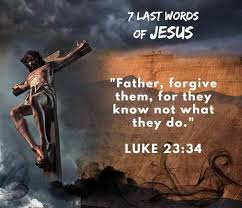
The Seven Last Words, by Venerable Fulton John Sheen
Three elements conspire in the making of every great message: a pulpit, an audience and a truth. These three were present in the two most notable messages in the life of Our Blessed Saviour, the first and the last which He delivered to mankind. The pulpit of His first message was the mountain side; His audience, unlettered Galileans; His truth, the Beatitudes. The pulpit of His last message was the Cross; the audience: saints and sinners; the sermon was the Seven Last Words.
In the four thousand years of Jewish history, the dying words of only three are recorded: Israel, Moses and Stephen. In His goodness, Our Blessed Lord has left us His thoughts on dying, for He more than Israel, more than Moses, more than Stephen is representative in all humanity. In this sublime hour, therefore, He calls all His children to the pulpit of the Cross, and every word He says to them is set down for the purpose of an eternal publication and an undying consolation. There was never a preacher like the dying Christ. There was never a congregation like that which gathered about the pulpit of the Cross. There was never a sermon like the Seven Last Words.
The First Word
Father, forgive them for they know not what they do!
It seems to be a fact of human psychology that when death approaches, the human heart speaks its words of love to those whom it holds closest and dearest. There is no reason to suspect that it is otherwise in the case of the Heart of hearts. If He spoke in a graduated order to those whom He loved most, then we may expect to find in His first three words the order of His love and affection. His first words went out to enemies: "Father, forgive them"; His second to sinners: "This day thou shalt be with Me in Paradise"; and His third to saints "Woman, behold thy son." Enemies, sinners and saints - such is the order of Divine Love and Thoughtfulness.
The congregation anxiously awaited His first word. The executioners expected Him to cry, for every one pinned on the gibbet of the Cross had done it before Him. Seneca tells us that those who were crucified cursed the day of their birth, the executioners, their mothers, and even spat on those who looked upon them. Hence the executioners expected a cry but not the kind of cry that they heard. Like some fragrant trees which bathe in perfume the very axe which gnashes them, the great Heart on the Tree of Love poured out from Its depths something less a cry than a prayer, the soft, sweet, low prayer of pardon and forgiveness: "Father, forgive them, for they know not what they do."
Forgive whom? Forgive enemies? The soldier in the court room of Caiphas who struck Him with a mailed fist; Pilate, the politician, who condemned a God to retain the friendship of Caesar; Herod, who robed Wisdom in the garment of a fool; the soldiers who swung the King of Kings on a tree between heaven and earth - forgive them? Forgive them, why? Because they know what they do? No, because they know not what they do. If they knew what they were doing and still went on doing it; if they knew what a terrible crime they were committing by sentencing Life to death; if they knew what a perversion of justice it was to choose Barabbas to Christ; if they knew what cruelty it was to take the feet that trod everlasting hills and pinion them to a limb of a tree; if they knew what they were doing and still went on doing it, unmindful of the fact that the very blood which they shed was capable of redeeming them, they would never be saved! Why, they would be damned if it were not for the fact that they were ignorant of the terrible thing they did when they crucified Christ! It was only the ignorance of their great sin that brought them within the pale of the hearing of that cry from the Cross. It is not wisdom that saves: it is ignorance!
If we knew what a terrible thing sin was and went on sinning; if we knew how much love there was in the Incarnation and still refused to nourish ourselves with the Bread of Life; if we knew how much sacrificial love there was in the Sacrifice of the Cross and still refused to fill the chalice of our heart with that love; if we knew how much mercy there was in the Sacrament of Penance, and still refused to bend a humble knee to a hand that had the power to loose both in heaven and on earth; if we knew how much life there was in the Eucharist and still refused to take of the Bread which makes life everlasting and still refused to drink of that Wine that produces and enriches virgins; if we knew of all the truth there is in the Church as the Mystical Body of 8 the seven last words Christ and still, like other Pilates, turned our backs to it; if we knew all these things and still stayed away from Christ and His Church, we would be lost! It is not wisdom that saves; it is ignorance! It is only our ignorance of how good God is that excuses us from not being saints!
Prayer
Dear Jesus, I do not want to know the wisdom of the world; I do not want to know on whose anvil snowflakes are hammered, or the hiding place of darkness, or from whose womb came the ice, or why the gold falls to the earth, earthly, and fire climbs to the heavens, heavenly; I do not want to know literature and science, nor the four dimensional universe in which we live; I do not want to know the length of the universe in terms of light years; I do not want to know the breadth of the earth as it dances about the chariot of the sun; I do not want to know the heights of the stars, chaste candles of the night; I do not want to know the depth of the sea, nor the secrets of its watery palace. I want to be ignorant of all these things. I want only to know the length, the breadth, and the height and the depth of Thy redeeming Love on the Cross, Sweet Saviour of Men. I want to be ignorant of everything in the world - everything but You, dear Jesus. And then, by the strangest of strange paradoxes, I shall be wise!